
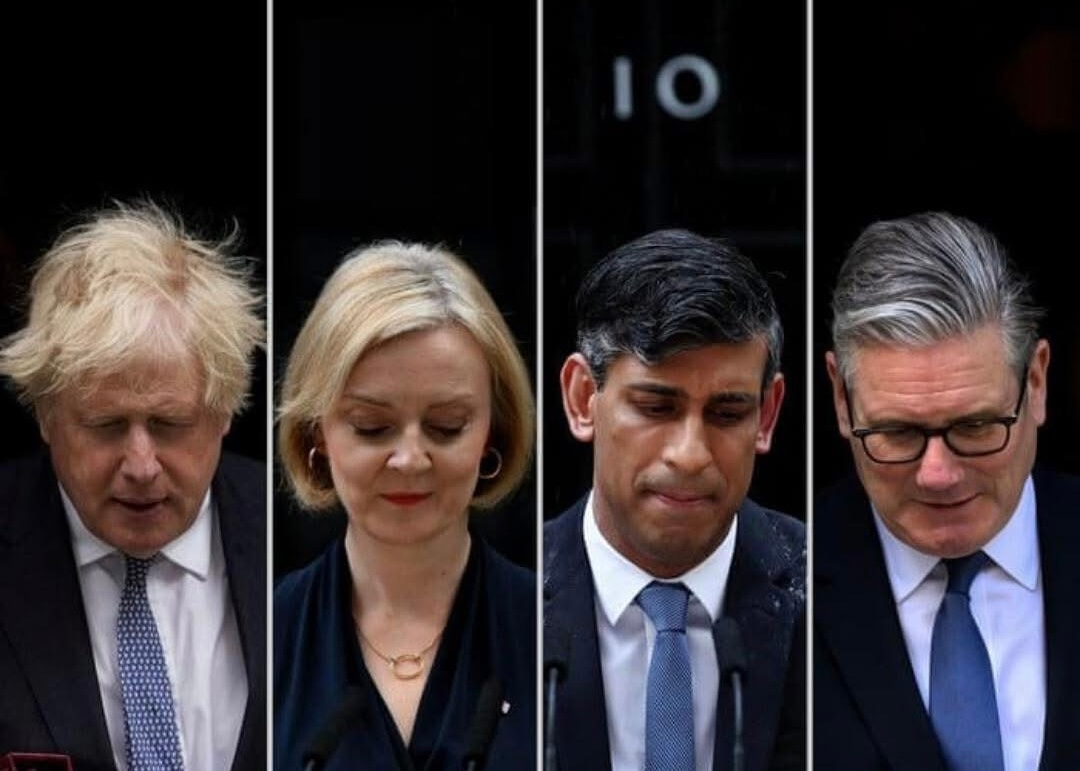
From Boris Johnson to Keir Starmer, Britain’s revolving-door leadership crisis is shaking markets, policy and global confidence.
MARKET INSIDER – Britain’s political instability is no longer just a Westminster drama. It is becoming a structural economic risk for one of the world’s largest financial centers, raising uncomfortable questions about whether the UK’s political system can still deliver long-term governance in an age of polarization, stagnant growth and social fragmentation.
From Boris Johnson and Liz Truss to Rishi Sunak and now potentially Keir Starmer, Britain has cycled through leaders at a pace that increasingly resembles unstable parliamentary systems once associated with postwar continental Europe rather than modern Britain. The deeper concern is no longer about individual failures, but whether the office of prime minister itself has become almost impossible to hold successfully.
Political historian Tom Clark draws a striking parallel with France’s Fourth Republic, the chaotic post-World War II era that collapsed under the weight of constant leadership crises before yielding power to Charles de Gaulle in 1958. The comparison would once have sounded absurd for Britain, long viewed as a model of political continuity. Today, it feels increasingly plausible.
Since the 2016 Brexit referendum, Britain has burned through six prime ministers, eight chancellors and nine foreign secretaries. That level of churn matters far beyond politics because governments cannot execute serious reforms when ministers barely remain in office long enough to understand their portfolios. Former Cabinet Secretary Gus O’Donnell recalled periods when Britain had nine pension ministers within five years — an extraordinary statistic for a policy area that requires decades of consistency.
The consequences are visible across the British economy. Infrastructure ambitions such as the country’s high-speed rail network were repeatedly scaled back. Tax reform efforts collapsed under political pressure. Welfare reforms were diluted before implementation. Even basic long-term planning on pensions, healthcare and defense spending became politically radioactive. The result is a country trapped between fiscal anxiety and policy paralysis.
Financial markets have noticed. Economist Paul Johnson argues that Britain is already paying billions more in debt servicing costs because investors attach a political instability premium to UK assets — a premium that surged during the disastrous short-lived premiership of Liz Truss, whose unfunded tax-cut plans triggered chaos in the British bond market and sent the pound tumbling. The shock shattered the perception that Britain was immune to emerging-market-style confidence crises.
Yet the roots of the turmoil may run deeper than economics alone. Britain’s postwar political consensus was once anchored by relatively stable class divisions and two dominant parties. Today, those lines have fractured into overlapping cultural, generational and ideological battles: Brexit, immigration, Gaza, housing inequality, identity politics and widening divides between older asset owners and younger renters. Social media has amplified every fracture line, turning coalition-building into an almost impossible balancing act.
That fragmentation has transformed leadership into permanent crisis management. Politicians spend more time surviving than governing. Theresa May’s premiership became consumed entirely by Brexit survival. Boris Johnson’s “levelling up” agenda collapsed amid scandal and inconsistency. Starmer’s promise to “end the chaos” now risks becoming another failed slogan as critics accuse him of lacking both political imagination and a compelling economic narrative capable of uniting Britain’s fractured electorate.
The irony is that Britain’s crises are unfolding precisely when long-term leadership is most urgently needed. Europe faces rising defense costs, slowing productivity, aging populations and intensifying competition from the United States and China. Countries that can sustain stable strategic policy over a decade may gain a decisive economic edge. Those trapped in perpetual political warfare may struggle to attract investment, build infrastructure or maintain public trust.
There are, however, signs that another path is possible. Historian Margaret MacMillan points to Mark Carney in Canada as an example of a leader attempting to level with voters about sacrifice, patience and the complexity of structural reform — a style increasingly rare in modern politics dominated by instant outrage and algorithm-driven attention spans.
Britain’s real challenge may therefore be less about replacing another prime minister and more about rebuilding a political culture capable of sustaining difficult decisions over time. Until that happens, Downing Street risks becoming less a seat of power than a revolving door — and global investors will continue pricing Britain accordingly.
