
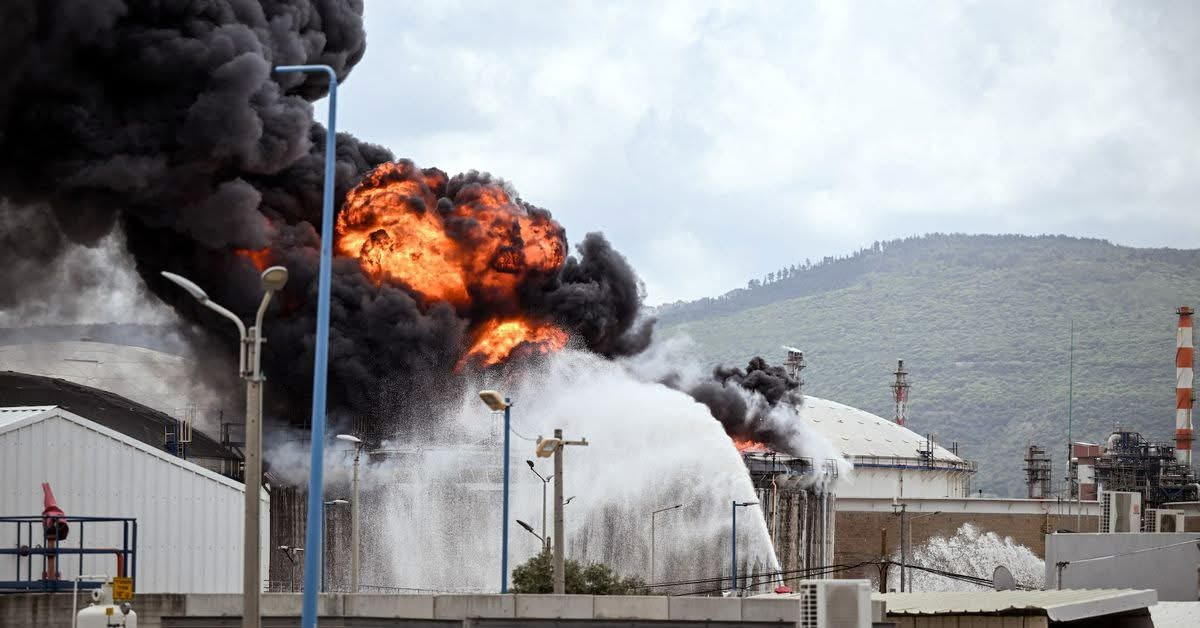
The strikes expand Washington’s campaign from sanctions to the physical disruption of Iran’s oil-export network.
MARKET INSIDER — The U.S. military destroyed five Iranian crude carriers after Iran’s Revolutionary Guard attempted to strike an American warship twice with ballistic missiles, sharply escalating a retaliatory cycle threatening energy flows through the Gulf.
U.S. Central Command said the warship evaded both attacks and no American personnel were injured. Crews aboard the five tankers were ordered to evacuate before the vessels were struck and rendered inoperable.
The operation brings the number of Iranian tankers attacked by U.S. forces since Saturday to eight, moving Washington’s economic campaign beyond sanctions and blockades toward the direct destruction of assets supporting Tehran’s oil revenue.
Key Highlights
- U.S. forces disabled five Iranian tankers in the Gulf of Oman and near Kharg Island after two unsuccessful missile attacks on an American warship.
- Iran retaliated by firing missiles toward U.S.-linked facilities in Jordan and threatened tankers using ports in Kuwait and Bahrain.
- Oil traded close to $100 a barrel as attacks on Iranian shipping and Saudi energy facilities raised the risk of prolonged supply disruption.
Five tankers struck in two locations
CENTCOM identified the vessels as the M/T Kaviz, M/T Charminar, M/T Horizon 1, M/T Riesco and M/T Derya.
The first four were attacked in the Gulf of Oman, while the Derya was struck near Kharg Island, the principal hub for Iran’s seaborne crude exports.
“American forces directed the crews to abandon ship before the vessels were struck and rendered inoperable,” CENTCOM said.
The command described the ships as Islamic Revolutionary Guard Corps crude carriers operating within a multibillion-dollar network used to finance the IRGC and Iran-aligned groups across the region. That description reflects the U.S. government’s assessment and does not by itself establish the vessels’ status under international law.
Iranian state media confirmed attacks on tankers near Kharg Island and the southern port of Jask. It reported that crews had evacuated, with no immediate indication of casualties.
The latest operation followed U.S. strikes on three other Iranian oil tankers on Saturday. CENTCOM said those earlier attacks were retaliation for unsuccessful Iranian ballistic-missile launches against an aircraft carrier and a guided-missile destroyer.
Iran responds with missile strikes and new threats
The tanker attacks triggered another Iranian response.
The Revolutionary Guard said it fired ballistic missiles at U.S.-linked facilities at Jordan’s Muwaffaq Salti Air Base in Al Azraq. Jordan’s military said its air defenses engaged 20 missiles, intercepting 18 while two fell in unpopulated areas without causing casualties.
Iran also claimed to have damaged American destroyers, although Washington has not confirmed those assertions.
More consequential for energy markets, the IRGC threatened oil tankers in Kuwaiti and Bahraini ports and warned crews to evacuate. Both countries host U.S. military forces and are important nodes in the Gulf’s energy and shipping infrastructure.
The threats widen the risk beyond Iranian and American assets. Kuwait is a major oil exporter, while Bahrain hosts the U.S. Navy’s Fifth Fleet. Attacks near their ports could disrupt commercial shipping, increase insurance costs and draw additional Gulf states into the conflict.
Iran has also said it plans to establish a new maritime exclusion zone affecting vessels approaching the Strait of Hormuz.
Washington targets the machinery of Iranian oil exports
The strikes reinforce President Donald Trump’s campaign to defeat Iran economically after efforts to secure a nuclear agreement failed to produce a settlement.
Until recently, the strategy relied primarily on sanctions, financial restrictions, pressure on foreign oil buyers and a U.S. blockade of Iranian ports. The tanker attacks represent a more aggressive phase in which Washington is physically disabling vessels allegedly involved in generating revenue for the Iranian government.
Oil exports provide Tehran with foreign currency needed to finance imports, stabilize its economy and fund military operations. Removing vessels from service can disrupt that revenue more immediately than adding them to sanctions lists, particularly when replacement ships, insurance and willing crews are difficult to secure.
But military action against commercial oil carriers also increases legal, diplomatic and environmental risks. Iran has characterized the attacks as acts of economic warfare and violations of international law.
The United States argues that the vessels support the Revolutionary Guard’s military financing. Whether individual tankers qualify as legitimate military objectives depends on their ownership, operational role and contribution to hostilities—questions likely to remain contested.
Oil approaches $100 as supply risks spread
Brent crude traded near $99 a barrel following the latest escalation, after briefly reaching approximately $99.46. The international benchmark has risen as markets price in prolonged disruption to Iranian exports and shipping through the Gulf.
The tanker strikes coincided with attacks by Iran-aligned Houthi forces on Saudi cities and energy installations. Those attacks injured more than 70 people and forced operations to stop temporarily at some facilities.
Brent settled near $98.63 on Tuesday as investors assessed the combined threat to Iranian shipping, Saudi production infrastructure and traffic around Hormuz.
A limited number of disabled Iranian tankers will not by itself create a global oil shortage. The larger risk comes from retaliation against Gulf producers, export terminals or ships carrying crude from countries allied with Washington.
Approximately one-fifth of global petroleum consumption normally passes through the Strait of Hormuz. Even without a complete physical closure, missile threats, vessel attacks, disrupted navigation and higher war-risk insurance premiums can reduce traffic and raise transport costs.
Markets are therefore responding not only to lost Iranian capacity, but to the probability that the conflict spreads across the region’s wider energy system.
Captured drone highlights autonomous warfare
A separate dispute developed after the Revolutionary Guard said it captured an advanced American unmanned submarine near the entrance to the Strait of Hormuz.
Iranian media identified the vehicle as a Dive-LD autonomous underwater system produced by U.S. defense company Anduril.
CENTCOM acknowledged losing the vehicle but described it as an older, defective system that malfunctioned while surveying regional waters. Navy Captain Tim Hawkins said it carried no classified sonar, radar equipment or sensitive data.
Anduril characterized Dive-LD as an “attritable” autonomous system designed for dangerous missions where the loss of an individual vehicle is an anticipated risk.
The episode illustrates the expanding role of unmanned systems in maritime surveillance, mine detection, reconnaissance and combat operations. Autonomous vehicles reduce the exposure of human crews but also create new risks of capture, reverse engineering and escalation when they enter contested waters.
Implications for markets and Asia
Asian economies are especially vulnerable to prolonged Gulf disruption because they purchase most of the region’s exported oil and liquefied natural gas.
China faces the most direct impact from efforts to suppress Iranian crude shipments. Buyers may still obtain discounted barrels through intermediaries and vessels operating outside conventional shipping networks, but physical attacks make those trades materially riskier.
Japan, South Korea and India are more exposed to higher benchmark prices and freight costs. For Southeast Asian economies, sustained oil near or above $100 would raise transport, electricity and manufacturing expenses while pressuring currencies and inflation.
Higher energy prices also complicate monetary policy. Investors are already increasing expectations for interest-rate rises by the Federal Reserve, European Central Bank and Bank of Japan as policymakers assess whether the oil shock will produce persistent inflation.
Equity markets may therefore face pressure through two channels: weaker profit margins and higher bond yields.
What investors should watch next
The most important indicator is whether Iran carries out its threats against tankers in Kuwait or Bahrain. Such attacks would transform a confrontation centered on Iranian exports into a broader threat to Gulf energy supply.
Kharg Island is another critical risk. A strike on the terminal itself, rather than tankers operating nearby, could remove a much larger share of Iranian export capacity.
Investors should also monitor Hormuz transit data, tanker insurance premiums and any naval commitments from U.S. allies. Falling traffic despite military escorts would suggest that commercial operators consider the risks unmanageable.
Finally, the possibility of renewed negotiations has not disappeared, but diplomacy is becoming more difficult as each strike creates pressure for retaliation.
The destruction of five tankers is economically more significant than another round of sanctions because it removes physical export capacity. Its greater importance, however, lies in the precedent: American warships are now directly targeting Iran’s oil logistics, while Tehran is threatening the energy infrastructure of U.S. partners.
That dynamic leaves oil markets one miscalculation away from a substantially larger supply shock.
