
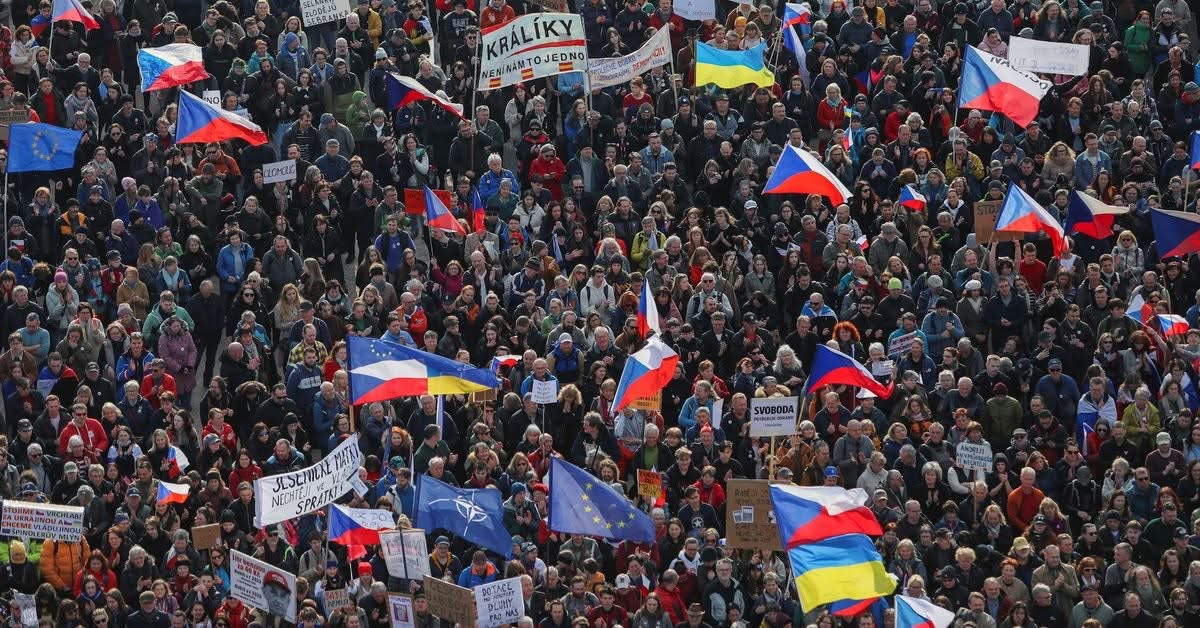
Tens of thousands flood Letna Plain demanding safeguards for democracy, public media independence, and NATO commitments
MARKET INSIDER – Tens of thousands of Czech citizens converged on Prague’s Letna Plain Saturday, March 22, 2026, in the country’s largest anti-government demonstration since the 2019 protests that toppled Andrej Babis’s previous administration—organizers estimated turnout at around 250,000. Waving Czech and EU flags, protesters voiced alarm over what they see as creeping authoritarianism under Babis’s newly returned populist ANO-led coalition with right-wing and far-right partners, including threats to public-media independence, defense-spending reductions, and potential curbs on civil-society funding.
The rally, organized by the pro-democracy group Milion Chvilek (Million Moments for Democracy), echoed fears that the Czech Republic could follow the paths of Hungary and Slovakia—neighbors repeatedly clashed with Brussels over rule-of-law violations. “We don’t want to be Hungary,” said teacher Hana Malanikova. “We don’t want to follow the Slovak Republic’s path. So it’s time to wake up.” A 22-year-old student, Tomas Chaloupka, added: “I’m here because I care about my country’s future… freedom and democracy are paramount.”
Key grievances include:
- Proposed changes to public-television financing that critics warn would erode editorial independence.
- A budget cut to defense spending amid NATO commitments and regional security pressures from Russia’s war in Ukraine.
- Tighter disclosure rules for NGOs that opponents view as stifling civil society.
The demonstration follows a February rally drawing up to 90,000 in support of President Petr Pavel, who has repeatedly clashed with Babis over ministerial appointments and defense priorities. Babis—whose business empire spans food, chemicals, and agriculture—returned to power in December after four years in opposition, reviving memories of the massive 2019 protests that forced his earlier resignation amid conflict-of-interest scandals.
For European investors and political risk watchers, the scale of Saturday’s mobilization signals deep societal unease at a time when Central Europe’s democratic backsliding remains a flashpoint for EU cohesion. While Babis’s coalition holds a parliamentary majority, sustained street pressure could constrain policy shifts on media and NGOs—or force concessions to preserve political stability. The rally also highlights broader regional tensions: as energy prices soar from the Iran war and defense budgets face scrutiny, public demands for fiscal discipline and democratic safeguards are colliding head-on.
The contrarian question emerging in Prague’s streets and Brussels corridors: can Babis weather this wave of protest as he did in 2019, or will mass mobilization—amplified by EU rule-of-law concerns—force a recalibration before the next election cycle? With turnout rivaling the peak of the anti-Babis movement seven years ago, the answer could reshape not only Czech politics but the resilience of democratic norms across Central Europe.
